
One sweltering afternoon in August, after visiting the bank, I discovered that every naira of my hard-earned savings had been stolen. I wasn’t sure how to react: to cry, scream, collapse, or roll on the hot sand. If anyone had seen me that day, they would have noticed my twisted lips, red eyes, and mouth so parched it felt as dry as the desert.
Before then, in the morning, I had woken up as usual and dressed for work, as I was an assistant lecturer at Nnamdi Azikiwe University, Awka. Awka is a city that pretends to be a city just because nothing in it is comparable to cities like Abuja and Lagos. I had a class to teach at 9 a.m. I don’t remember exactly what I had prepared to teach, but by deduction, it must have been something about the Romantic period. This was 2021. I walked out of my apartment after I made sure I had locked it securely and headed to my car. It was a Honda Civic that had grown and experienced with me since 2009, been to the mechanic so many times I couldn’t keep count, stopped in the middle of a journey, swam through a flood without giving up, and one time had grown a huge boil on one tyre, which was suffering from wear and begging to be changed. That morning, for reasons beyond me, the car simply refused to start. I popped the hood, inspecting everything I thought could be the issue, but nothing seemed out of place. It coughed three times on starting before falling into an eerie silence. I called the mechanic, who assured me he would come look at it in the evening. With no other choice, I stepped out of the compound, waiting and waving down a Keke, a public tricycle, to take me to the university.
One of my local club football teammates came along as I stood waiting and waving. Our conversation started lightly, then stretched into something longer on training and matches. I had to abandon the Keke idea altogether and opted for a bus ride instead. It was cheap. Inside the bus, we continued our conversation. The bus made its stops, picking up and dropping off passengers. Since the bus also ran through the university, I relaxed, knowing it would take me straight to the Arts faculty. My teammate was headed the same way. When we reached our final stop, we paid our fare. As the bus pulled away, I reached into my pocket for my phone. I checked one side. Then the other. My wallet sat there. But my phone, my phone was gone. I checked again. And again. Somewhere between the conversation, the stops, and the movement of the bus, it had been stolen.
I walked straight to my mum’s office, just three doors from mine. I asked her for her phone, which I used to dial my number. It rang, once, twice, and then on the third try, I silently begged, please, someone pick up. But no one answered it. I heaved a sad sigh. On the fifth try, the phone was unreachable. At that moment, the cruel truth hit me. There was nothing more I could do. The institution I banked with, with its app sitting on my phone’s home screen, was just a minute’s walk from the faculty, but at the time, I hadn’t thought to be cautious. I had trusted my phone, believing it was safe and secure. I relied on this trust and then focused on the class I had to teach that morning. My students were waiting, their eyes wide with surprise as I walked in. They were used to my punctuality and my refusal to entertain lateness.
After two hours of discussing Wordsworth, Coleridge, and the complexities of poetry, I left the class and made my way to the bank. There, I stood in line at the counter. When it got to my turn, I told the teller I wanted my bank account temporarily blocked. She took my details and then, with a level of calm that felt almost too clinical, asked, “Why exactly do you want to block this account?”
“My phone got stolen this morning,” I said.
“Well, Mr Chinua,” she said. “I think your account has no balance.”
I cringed at that, my stomach twisting into knots. My face said it all. No, that can’t be true. But she only swirled her chair slightly, tilting the desktop screen toward me, showing me what she had been staring at. Knowing the state of the country, there was nothing the bank could do to help. The phone I had thought was impenetrable, fortress-like, was nothing more than flimsy. My entire savings vanished into the ether. I didn’t need a second to grasp the harsh simplicity of the zeros sitting as my account balance.
I went home devastated. Food lost its taste in my mouth, and I couldn’t bring myself to eat for two days. My mother sent me a hundred thousand naira to help me buy a new phone, hoping it would lighten me up. But that wasn’t the real wound. The money, all of it, the hard-earned savings I had set aside, some of which was meant for PhD applications in the United States, had been stolen. Like gone-gone, as if it had never existed. The more I thought about it, the more my empty stomach trembled. The pain in my heart swelled, heavy and immovable. My sister, Nnedi, and my youngest brother, Uche, sat with me in my loss.
“Sorry, big brother,” they said to me. “This will pass. Things will be better.”
Did things get better, especially living in Nigeria? No. But they didn’t get worse for me. Two months later, my younger brother, Onyedika, who was still finding his footing in the world, came through for me in a way I never expected. He paid for my PhD program, the very one I was wrapping up at Nnamdi Azikiwe University, where I also served as an assistant lecturer. Meanwhile, my cousin, who was living somewhere in England, heard about what had happened to me. Without hesitation, she offered to pay for an application to any university of my choice in the United States. By this time, I had begun to let go of what had happened and focus on what I could do next. I walked into the university every day, going about my work as if nothing had happened. I was brought up to embrace life and its incongruities and to understand that loss is part of living. However, when I try to forget this lesson, Nigeria, with its constant hardship, reminds me otherwise. This country gives no time to stop and mourn. It keeps going fast, whether one is ready or not, whether one is healed or not. So, in the relentlessness of it all, I must find my footing again.
In November, I messaged my cousin and reminded her of her promise. This cousin of mine, Amarachi, whom I had grown up with, and whose brilliance I had always known, not just from her grades but from the light in her eyes, the way she carried herself, and the way she understood life by always staying calm, asked for my details and the link to make the payment as promised.
“Why this University?” she asked me on receiving the details.
“Kwame Dawes,” I said.
“Who is that?” She asked.
“That’s Noah of all things.”
We laughed over the phone.
Thereafter, I thanked her for the wonderful gesture and said our goodbyes. Weeks went by, and I gradually forgot about the application and concentrated more on living in Nigeria and my relationship with Mmesoma, whom I met at the faculty. I grew to appreciate her stubbornness towards life. And beneath that stubbornness was a heart filled with exquisite goodness and unmatchable affection; it was so familiar, like the kind only my father and mother had ever shown me. It was pure. I would later come to call it love in its truest sense, in all its complexities and grace.
In late January 2022, I received an email from the graduate school and the graduate chair of the English Department of the University of Nebraska-Lincoln, USA, stating that I was admitted to their PhD program for creative writing. It was fully funded. This email, unexpected at the time I received it, thrilled me beyond wonder. I was filled with joy and happiness. I called everyone I knew. Thanked my cousin for her help. I was finally going to study what I truly wanted, and no university in Nigeria was interested in it yet. One of my friends, Olisa Eloka, who heard the news from someone, called and congratulated me. And then said, “Lincoln, Nebraska? I have never heard of it.” Truly, at that time, not many people in my circle had heard of it. I only knew of the city and the University because of my interest in Professor Kwame Dawes and his works.
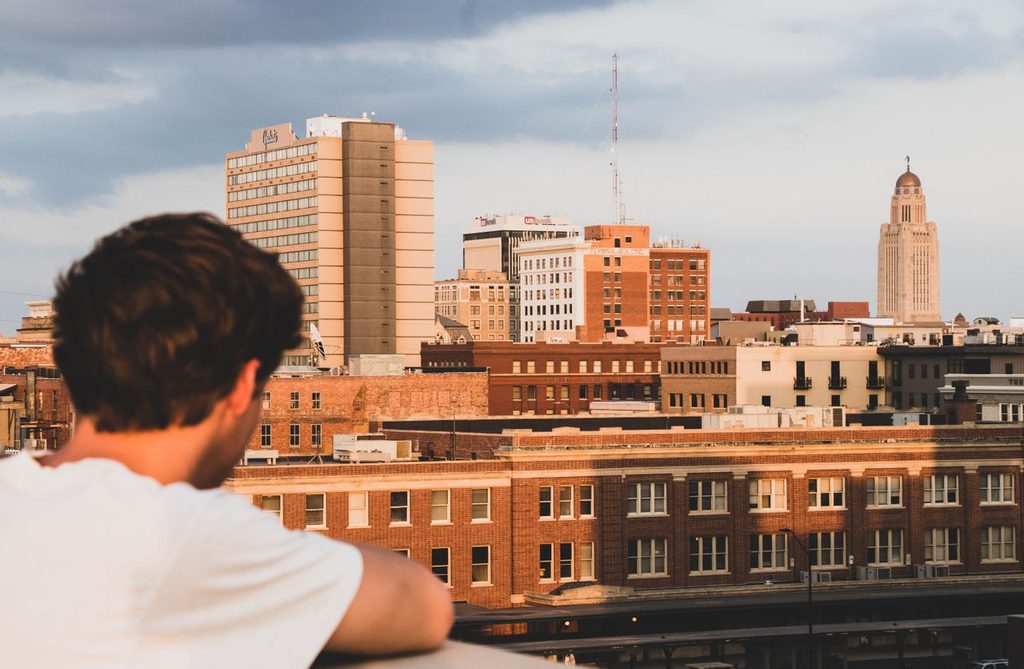
I was set to be in Lincoln on August 22 to start my program. But first, I had to pause an ongoing PhD, one that was almost completed at the University where I served as an assistant lecturer. There was a mountain of things to sort out: renewing my passport, buying flight tickets, securing the visa and SEVIS fee, and finding an apartment in Lincoln. But above all, I had to pay the bride price of the woman I had just proposed to. All these tasks weighed heavily on me. Each required attention, and none came without its cost. My salary, though unsteady, wasn’t enough to cover half of it, so I had to find a way to make it work. And I did. Together, my younger brother, mum, uncle Chijioke Tassie, Pa Ikhide, Akachi Adimora-Ezeigbo, and GoFundMe, opened by Unoma Azuah, assisted me in renewing my passport via express, securing international flight tickets, paying for visa and SEVIS fees, the demanded local flight tickets, and having enough for the first rent in Lincoln, as I paid the bride price and took care of other things.
For an apartment, a friend suggested I reach out to Rasaq Malike Gbolahan, a fellow poet and PhD student at the University of Nebraska-Lincoln. I contacted him, and his response was warm. As fate would have it, his apartment mate was moving out, and we agreed that I would take his place.
June came, and I went for the visa interview. Approval was granted. July passed in a blur of family time and moments with Mmesoma, who was now my wife. We wished the days would slow down, but instead, they sped by like a bullet train. August came, and we stood on the threshold of goodbyes, tears welling up in our eyes at the airport. We made promises that we have kept to this day. And because I valued privacy, a trait I inherited from my parents, I chose to keep my marriage away from social media. Not because I feared anything might go wrong, as some would think, but because I wanted my personal relationships and work to remain distinct, treated in their own rights. Work must be separated from the private world of my life and family.
When my friends heard of my intention to get married before the trip, they raised their eyebrows. They raised them so high I thought I was sinning. This was because they assumed I would never settle down, as they had witnessed the way I lived and how I always said that marriage was never for me. And even if it were for me, I would beat King Solomon in numbers. This was my way of jokingly escaping such discussions with friends. One of my friends, one evening, advised me to abort the marriage; his reason was that where I was going had more, perhaps better. The ones who would never disturb me for Peruvian hair or demand more than I could provide, and so on, he said as we shared grilled catfish and beer.
When I arrived in Lincoln, Nebraska, I was filled with enthusiasm and goals. On stepping out of the Lincoln Airport, the sky stretched wide in the hues of dusk. I had with me pages of dreams, prayers from those who had wished me well, and the certainty that I was stepping into a chapter that would propel me in ways I could not yet foresee. Days after my arrival, I met Chigozie Obioma, one of the English Department’s faculty then and a two-time Booker Prize Finalist; he welcomed me with open arms in his office and smiled a lot. I also met Kwame Dawes, soft-hearted and hardworking, who was the reason I started the journey. His office was majestic, filled with books and documents. When I looked him in the eyes, I felt instantly, with a resounding assurance, that this was the man I had been looking for and wanted to work with. And so I was happy. He welcomed me with a warm smile. And as days went by, he turned out to be my favourite teacher and supervisor, and I enjoyed so much the privilege of being in his classes. I also met Funke Ogundimu, Zainab Omaki, Ber Anena, Akua Manieson, and Uche Okonkwo. I felt everything I wanted was here, in the city, and at the University.
Slowly, Lincoln was transforming into a second home, but the process of learning and accepting it was exhausting. It wasn’t just about adjusting to the climate or the unfamiliar faces; it was about adapting to an entirely new way of being. In my first noon class, jet lag took hold of me. My eyelids grew heavy, and before I could protest, I was asleep. When the break came, I went straight home to my apartment. That didn’t sit well with the professor whose class I was taking. She emailed me that evening, and I apologised, explaining that I couldn’t handle the sleep that had gathered in my eyes due to jet lag. Lincoln is six hours behind Nigeria, and seven hours during daylight saving time. The following week, I tried to fight the jet lag as much as possible, but I couldn’t. Instead of leaving the class, I slept right there. Inside the class. I don’t remember if I snored or not.
As the weeks stretched on, I began to untangle the intricacies of my new world. The first shock Lincoln gave me came when I discovered that what had been promised as a fully funded program was, in reality, not so. I would still have to fork out an additional $1500 every summer and fall as a student fee. Then came the humbling truth about the politics of language. Despite the compliments on my writing as “excellent English,” I found myself constantly fighting an invisible barrier of people not quite hearing the things I said. I remember telling one professor, with a quiet defiance, “One thing I will never lose is my accent.” Every semester, the students whom I taught would inevitably comment on what they deemed a “strong accent,” to which I would calmly respond, “Outside your country, wouldn’t you think you would have an accent?”
In the bit of understanding Lincoln, I stumbled on its politics of language, which back home would have been firm directives and nothing more; but here, they came as polite questions or requests, that in their entirety were not truly polite but impositions wrapped in courteous phrasings or expressions. In other words, diplomatic pretences. Expressions such as “Would you like to answer the question?” or “You might want to consider…” had less the openness they implied and more the expectation of compliance. Even gentler ones like “It would be helpful if you…” or “Try to have this ready before class” or “You should definitely take a look at this book” or “You may want to start working on the paper early” functioned as unmistakable imperatives. What appeared, at first, as kindness or flexibility was, over time, a form of diplomatic speech, I would say. Not quite coercion, but not entirely choice either.
The irony of it all struck me each time I heard the phrase, “Chinua, I am happy to meet you. If you need anything, please let me know.” Those words would ricochet in my mind. The first time I actually needed something, I called and texted the very people who had so warmly extended their offers of help. The silence I got from them was deafening. My calls went straight to voicemail, and my texts were unanswered. I remember, in my second year in Lincoln, when I went to the dentist. After the dental procedures, I was offered some brushing items: “Do you want these?” Toothbrushes and a special toothpaste. Knowing I had a pack of unused toothbrushes and toothpastes, I respectfully nodded a “No.” And with a red face and mild irritation in her voice, the dentist responded, “You must have them.” She placed them on my thighs.
One time, a young man I met at a Bank asked me, smiling, when inquiring where I came from and trying to locate it on the world map on his phone, if Nigeria was in South America. I was shocked at hearing that. Then I thought to myself: had the man mistaken Nicaragua, in Central America, for Nigeria? Funny!
When Rasaq, who is now my apartment mate, and I went to Walmart after visiting an African store to buy the food we wanted, we agreed to leave our bags at the entrance, in the corner where the shopping carts were kept. Rasaq had lived in Lincoln before me, so when he assured me that our things would be safe there, I trusted him. We went inside Walmart to get a few more items, expecting to return to everything we had left behind. An hour and a half later, when we came back out, our bags were gone. For a moment, we were both confused, almost unable to believe that someone had taken them. We went to the security personnel, explained what had happened, and expressed our concerns, but there was little they could do. We eventually went home disappointed.
It was only after coming to Lincoln that I began to accept something I had resisted for a long time: that it is all right if people do not pronounce my name perfectly. I found myself wondering, too, how anyone here would manage a name like Chinualumogu, when even Chinua seemed to trouble their tongue. What unsettled me was not the error itself, but the ceremony of effort— the anxious performance of getting it right. I have never quite liked that moment. It can feel less like recognition and more like a small spectacle. Historically, the United States of America has not always made room for such care. During the great waves of immigration in the nineteenth and early twentieth centuries, names were often shortened, altered, or mispronounced, sometimes for convenience, sometimes under the pressure to assimilate. Ellis Island— a small island in New York Harbour, located between New York City and Jersey City served as the main U.S. immigration processing centre from 1892 to 1954, where millions of immigrants first arrived in America —has become emblematic of this process, whether in fact or in memory—a place where names were said to be simplified to fit a new world. The expectation, broadly speaking, was simply to fit in. In more recent decades, however, that expectation has been altered. The language of civil rights, multiculturalism, and global exchange has reframed the question of names, so that pronouncing them correctly is now often seen as a gesture of respect, an acknowledgement of identity rather than an obstacle to it. I understand this explicitly, and I recognise its value. Yet my own experience remains more modest. Since arriving here, most people have not pronounced my name quite right—just as I have not always pronounced some of theirs or some of the American words correctly. Still, we try. And in that effort, imperfect as it is, I till now find that I am contented with approximations, with what sounds close enough to Chinua. After all, we come from different places, with different tongues, and the attempt itself—without anxiety, without performance—should be enough.
I remember my first week in Lincoln, when in one evening, I ventured out on foot. I had wanted to explore the city. I had no phone service yet and no map to guide me. I thought I could find my way back by exemplifying Psychogeography, which was first developed by Guy Debord, but what I am referring to here is its aspect known as flânerie, which is the act of wandering and observing urban life, often linked to Charles Baudelaire, and is more about observation than emotional mapping. I don’t remember how far I walked during the Lincoln venture until the familiar landmarks began to fade, and every street looked the same to me at that time, which contributed drastically to my confusion. I couldn’t read the street signs properly either because the way the streets are patterned is different from how they are done in Nigeria. As the daylight waned and darkness began to creep in, I realised I was lost. I asked passersby for directions, but the responses were fleeting. Some waved me off with a polite smile. Others didn’t stop at all. The minutes turned into half an hour, and with each step, my legs grew heavier. I was thirsty. My hips begged for rest, but I had to get to my apartment. I kept walking until, finally, after what felt like an eternity, I saw the building of my apartment. I had passed it three times already without even recognising it. I laughed and sighed at myself at this realisation.
Lincoln, Nebraska, is a place that is mostly quiet and has stretches of prairie and orderly neighbourhoods, where some streets run long. At G Street, where I first lived, the city was disturbingly calm. Sometimes, the calmness ate at me because of where I lived in Nigeria. But downtown Lincoln is nothing close to calm. In spite of this, I had begun to carve out a space for myself. I made a few friends, and in time, I found a football group at the University’s recreation centre, which was exclusively African. We dominated training sessions and matches whenever I was on the field. Our training days were Fridays, and they became the highlight of my week. By the following year, we reached the Semi-finals in the recreation center’s tournament. The year after, we won. I like to believe that my presence on the field and the energy I brought were part of that success. The same year, I was a panellist at the Association of Writers and Writing Programs (AWP) on the theme of “Re-imagining Place: New Voices from the Midwest” at Kansas City Convention Centre, February 7- 10, 2024. This was a huge win for me and my career.
Amidst these wins, there was a void. My wife wasn’t with me. We had tried a few times to get the F2 visa, but those times, she was denied. The reasons? Never clear. It was a frustration I couldn’t shake off. To make matters more complicated, I had to travel back to Nigeria during the holidays. The trips were costly, too costly for a PhD student who lived on a tight budget. I didn’t mind.
I have been living in Lincoln for three years now, maybe more when this essay gets to you, and I am doing well. Lincoln, Nebraska, in the Midwest of the United States of America, is experiencing me in my fullness, supplication, and progress. I am thriving more than I ever thought I would. To borrow a few words from G.G. Townsend, I have accepted my role in the communal, uncommunal, sophisticated, vile, and cruel play that is life and life in Lincoln, as I sometimes do not understand or recognise my role, and act it out even in those moments when the meaning is lost on me.
And so, to bring this reflection of coming to Lincoln to an end, I mean this end, here is a poem I wrote which first appeared in my poetry collection, The Naming, published by African Poetry Book Fund, under their book series, via Nebraska Press and contains some adjustments of Peter Drury’s exaltation of Cristiano Ronaldo on his return to Manchester United Football Club:
It was curiosity that led me to you, Lincoln.
It was curiosity that led me to you, Lincoln.
You city. City of touch and tease,
immaculate, foxy, and reeved in a gallery of vintage.
Reeved in red, ease, unease and cornfields.
With you, I was made to drift toward reason
and still hold onto faith and resilience.
With you, I discovered how much it meant to not be
liked by people around me and who flashed me fake smiles.
One time like that, you mischaracterised me for being a human
who genuinely cared, rode the test track rightly,
and simply did what any considerate human would do
—buying loaves of bread and sharing every slice.
Lincoln, you modern-Emmett-Till-ed me.
What does my passport mean to you, Lincoln?
In one hot afternoon, a black lady I met down
the street gifted me a nod. It took me hours to
understand that the nod was also an acknowledgement.
The following day, I gifted a young man on a skating
board double nods as a sign of sharing and aptitude.
Lincoln, you were privileged to have me submerged
in these conflicting experiences with you.
You once said I had an accent, but what I really heard was
that you had a bad ear and a thick accent.
What does my passport mean to you, Lincoln?
Every memory gained was a tiger claw survived.
Every scar(e) survived was another day attained.
Lincoln ⸻you city of touch, tease and unease;
you city beyond evaluation and maturity:
I must confess again: it was curiosity that led me to you.